
Product Overview
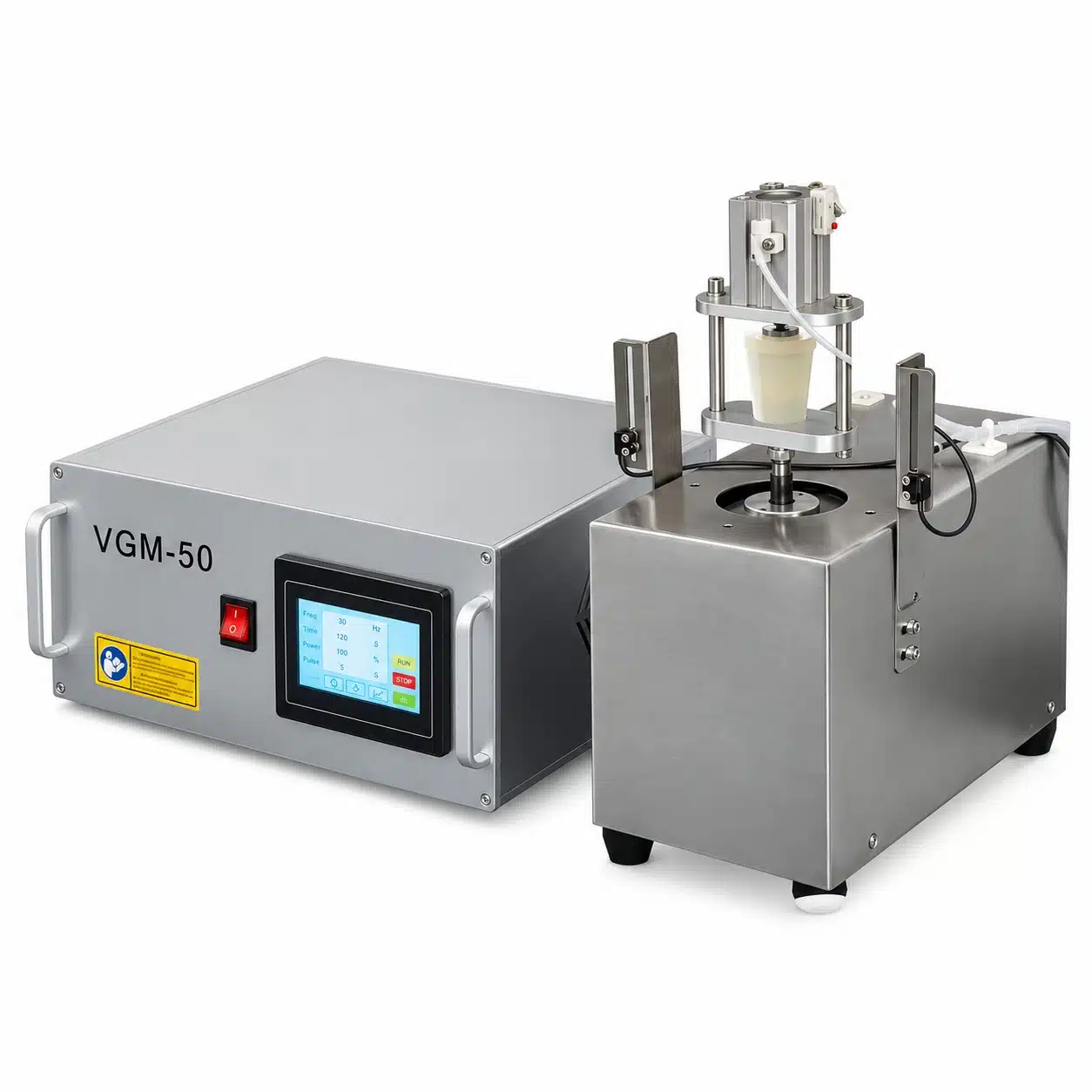
The VGM-50-AM is a programmable, automated high-energy vertical impact grinder and mill designed for laboratory-scale crushing, fine grinding, powder mixing, and advanced materials preparation. Featuring a high-frequency vertical vibration mechanism, the system delivers powerful mechanical impact energy for processing ceramic materials, metal oxides, battery materials, and other research samples.
The machine operates with an adjustable vibration frequency of 300–1600 cycles per minute and a nominal vibration amplitude of 16 mm. With an estimated maximum acceleration of approximately 80G, the system provides intensive grinding action through repeated collisions between the milling media and sample particles. This enables researchers to perform coarse crushing, intermediate grinding, and fine particle milling by selecting suitable grinding ball sizes and operating conditions.
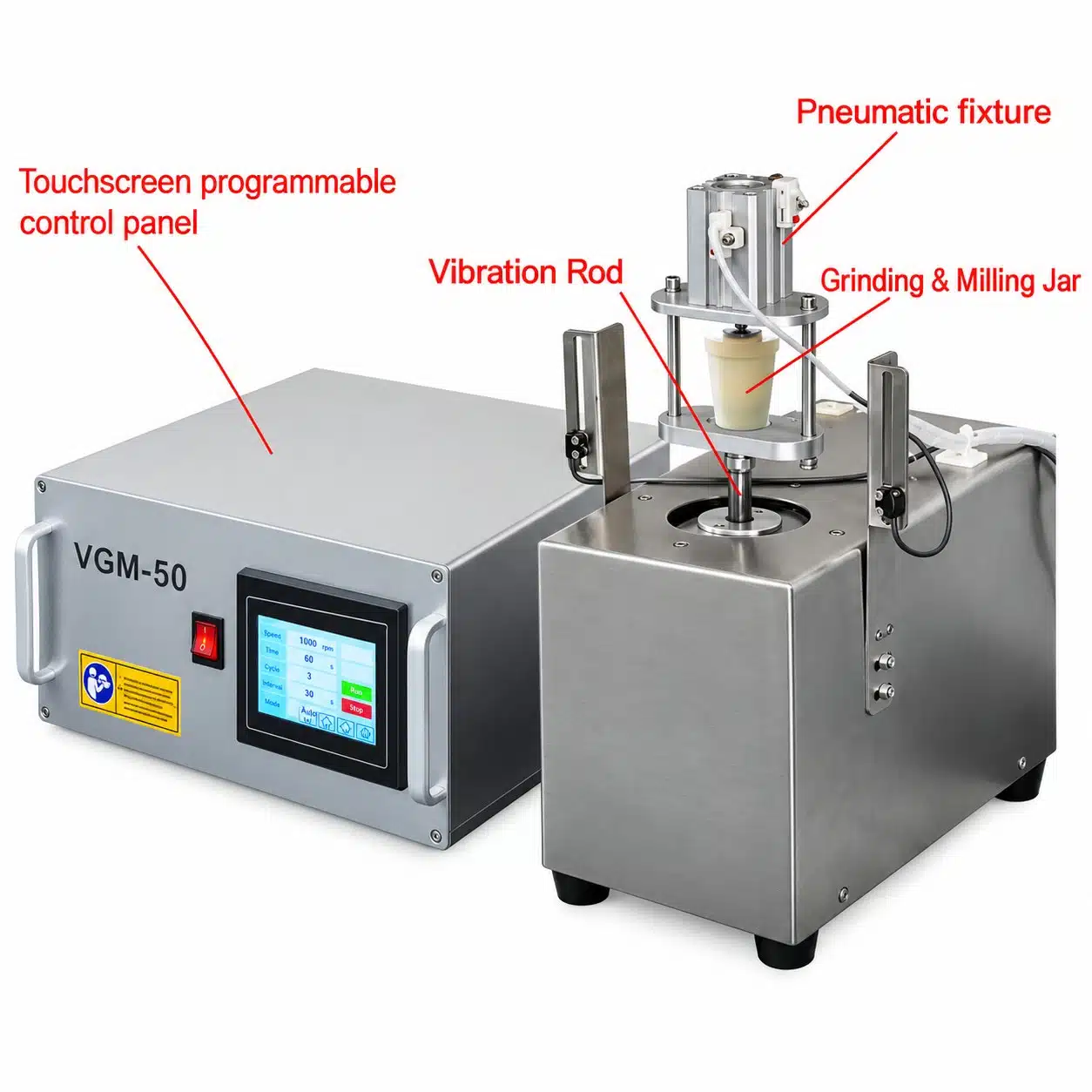
The VGM-50-AM is powered by a 24V DC motor and features a separate programmable touchscreen control unit. The controller allows users to configure milling speed, running time, rest and cooling intervals, and manual or automated operating modes. This configuration provides flexible control for different material preparation requirements.
The equipment supports selected grinding jars with nominal capacities ranging from approximately 1.5 mL to 90 mL, depending on the jar and holder configuration. The referenced package includes a 90 mL airtight zirconia grinding jar with compatible ceramic milling balls. Additional stainless steel, PEEK, silicon nitride, and zirconia jars may be available for specialized applications.
For increased automation, the VGM-50-AM supports both manual and pneumatic jar holding systems. The pneumatic fixture allows compatible jars to be secured through controlled actuation. Optional RS485 communication, PC-based software, and robotic arm integration can further support automated sample handling and coordinated multi-device operation.
The VGM-50-AM is suitable for university laboratories, battery research facilities, materials science institutes, and industrial R&D departments. Its combination of high-energy milling, programmable operation, and optional robotic integration makes it particularly useful for experimental powder preparation and automated materials research.
Key Features
- High-Energy Vertical Impact Grinding: Powerful vertical vibration generates repeated collisions between grinding media and materials for effective crushing, grinding, and powder homogenization.
- Adjustable Vibration Frequency: Operating range of 300–1600 cycles per minute for different processing requirements.
- 16 mm Vibration Amplitude: Large-amplitude vibration supports intensive grinding media movement and material impact.
- High Milling Acceleration: Estimated maximum acceleration of approximately 80G under specified operating conditions.
- Programmable Touchscreen: Provides control of vibration speed, operating duration, and rest intervals through a separate control unit.
- 24V DC Motor: Supports operation with a separated controller in compatible laboratory environments.
- Argon Glovebox Compatibility: Suitable for consideration in compatible argon-filled gloveboxes, subject to electrical and installation requirements.
- Multiple Milling Jar Options: Supports selected grinding jars in different materials and capacities for a wide range of experimental applications.
- Manual and Pneumatic Clamping: Offers flexible jar securing options for conventional and automated milling workflows.
- Optional RS485 Communication: Compatible PC software may support coordinated operation of up to eight units.
- Optional Robotic Integration: Robotic arm and control software may be integrated for automated jar loading and unloading.
- Versatile Research Applications: Suitable for sintered ceramics, battery materials, metallic powders, metal oxides, and advanced functional materials.
Technical Specifications
| Model | VGM-50-AM |
|---|---|
| Product Type | Programmable Automated High-Energy Vertical Impact Grinder and Mill |
| Grinding Method | High-frequency vertical impact and vibration milling. |
| Working Voltage | 110–240V AC, single-phase, 50/60 Hz. |
| Maximum Power Consumption | 400W. |
| Motor Type | 24V DC motor. |
| Vibration Frequency | 300–1600 cycles/min, adjustable. |
| Vibration Amplitude | 16 mm. |
| Estimated Maximum Acceleration | Approximately 80G under the stated operating conditions. |
| Programmable Time Range | 1–6553 seconds. |
| Control Interface | Separate programmable touchscreen control unit. |
| Operating Modes | Manual operation and automatic programmable operation. |
| Programmable Parameters | Vibration speed, running time, and rest/cooling intervals. |
| Grinding Functions | Coarse crushing, intermediate grinding, fine particle milling, powder mixing, and homogenization. |
| Typical Crushing Feed Size | Coarse samples below approximately 12 mm, using suitable 5–15 mm milling balls and verified loading conditions. |
| Intermediate Grinding Feed Size | Samples below approximately 5 mm, using suitable 5–8 mm milling balls. |
| Fine Milling Media | Selected 2–5 mm grinding balls may be suitable for fine particle processing, depending on the material. |
| Typical Output Particle Size | Approximately 0.1–5 µm may be achievable for selected materials under optimized processing conditions. Results are material-dependent and not guaranteed. |
| Milling Jar Capacity Range | Selected compatible jar configurations from approximately 1.5 to 90 mL; availability and fixture compatibility must be confirmed. |
| Standard Grinding Jar | One 90 mL airtight zirconia grinding jar in the referenced standard configuration. |
| Standard Grinding Balls | Referenced configuration: five 5 mm zirconia balls and two 10 mm zirconia balls. Confirm final supply quantities before ordering. |
| Optional Jar Materials | Stainless steel, PEEK, silicon nitride (Si3N4), and zirconia, subject to compatibility and selected capacity. |
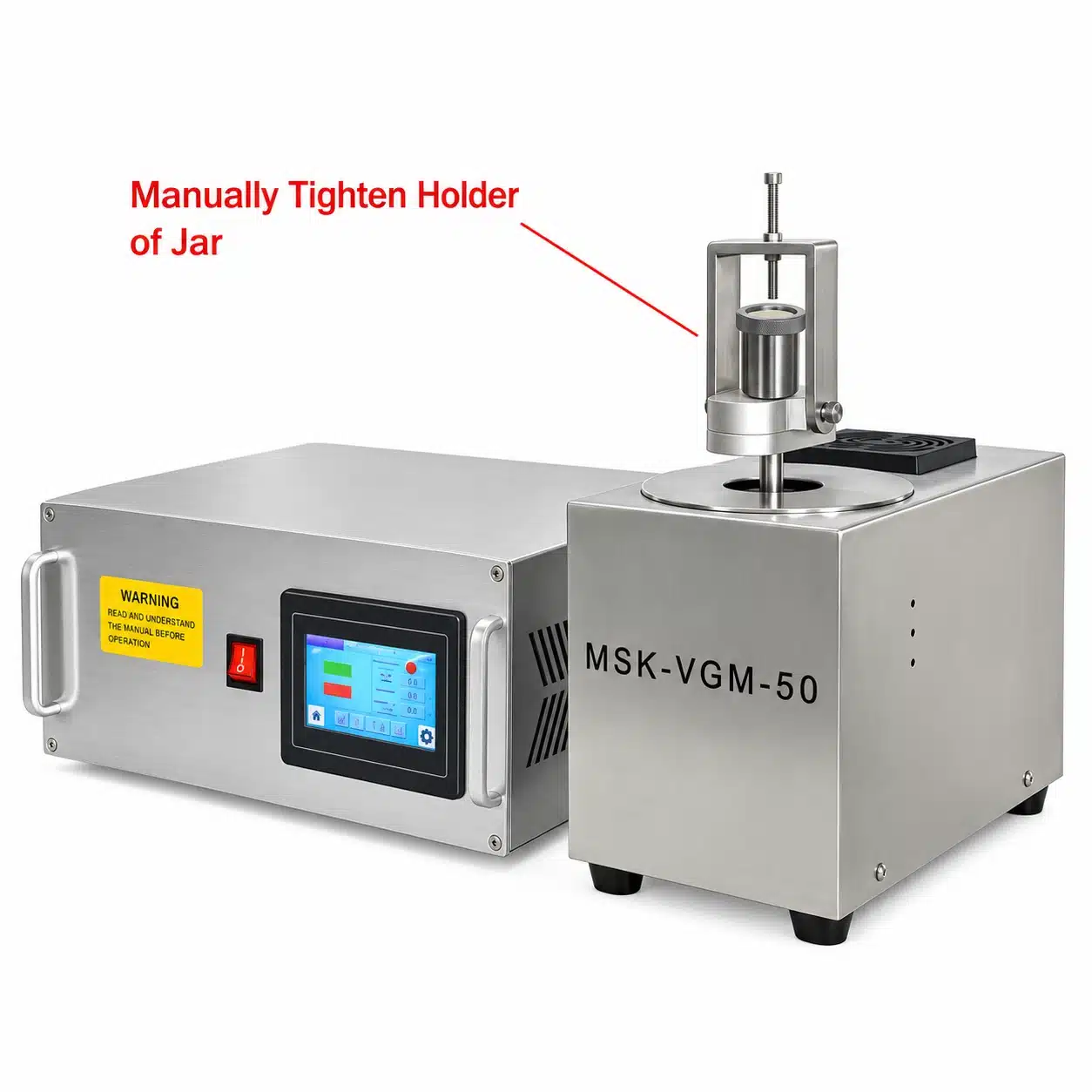
| Standard Jar Holders | Manual tightening holder and pneumatic clamping holder in the referenced configuration. |
| Manual Holding System | Mechanical holder for manual tightening and securing of compatible milling jars. |
| Pneumatic Holding System | Pneumatic jar fixture with controlled clamping actuation through the supported control system. |
| Pneumatic Supply Pressure | 0.4 MPa (approximately 4 bar). Confirm the approved operating pressure and compressed-air requirements. |
| Compressed Air Source | Suitable regulated compressed-air supply; an optional air compressor may be available for installations requiring a separate source. |
| Glovebox Compatibility | Designed for compatible argon-filled gloveboxes, subject to electrical, pneumatic, and installation verification. |
| PC Communication | Optional RS485 communication interface and compatible PC software. |
| Multi-Device Operation | Optional PC-based control for up to 8 compatible devices, subject to the software and communication configuration. |
| Robotic Arm Integration | Optional robotic arm and control software for automated jar loading and unloading workflows. |
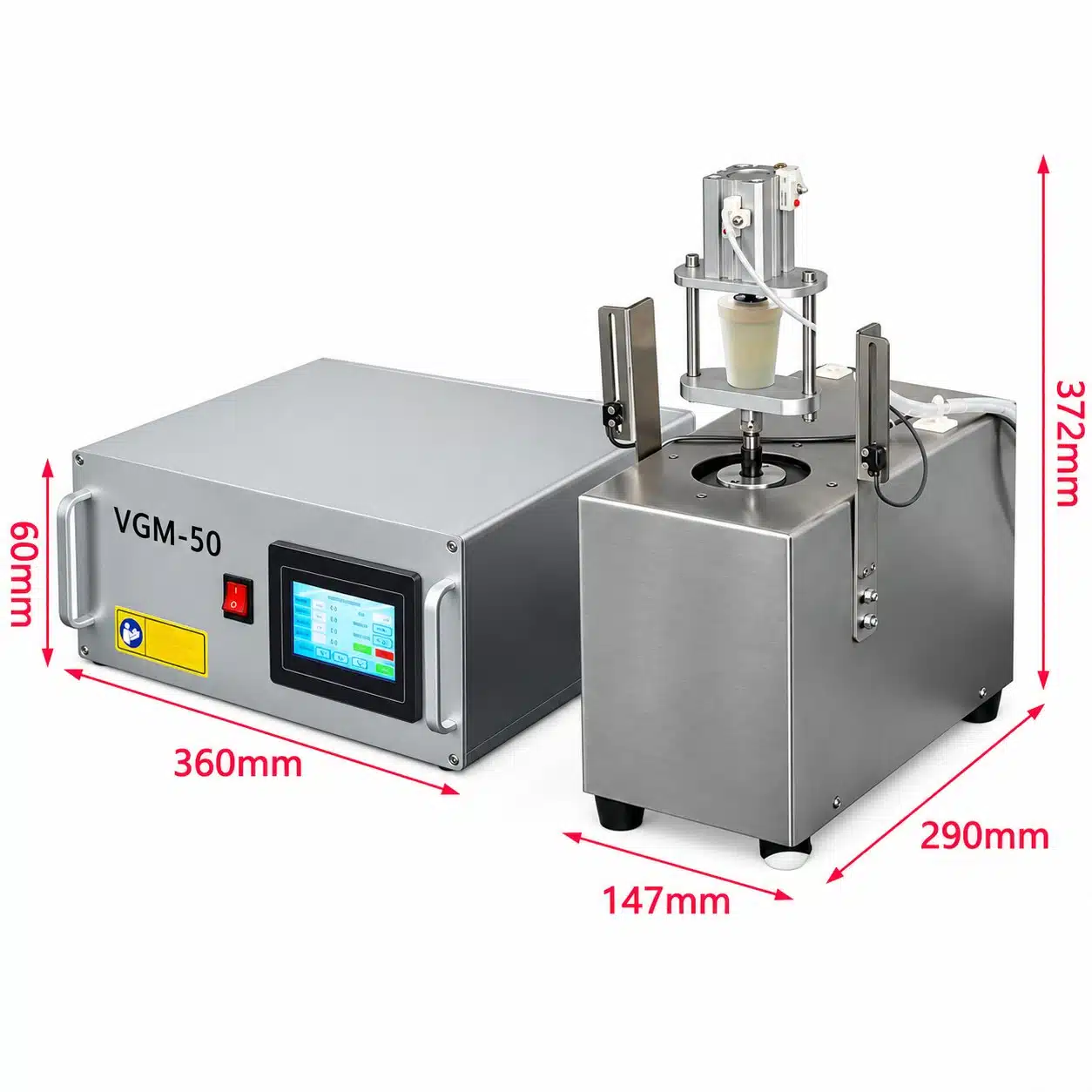
| Vibration Mill Dimensions | 147 × 290 × 372 mm (L × W × H), pending final dimensional confirmation. |
| Control Unit Dimensions | 360 × 290 × 60 mm (L × W × H), subject to confirmation. |
| Net Weight | Approximately 15 kg. |
| Compliance | CE documentation and optional NRTL certification requirements should be confirmed for the actual supplied configuration. |
High-Energy Grinding Performance
The VGM-50-AM combines high-frequency vertical vibration with a 16 mm nominal amplitude to generate repeated mechanical impacts during milling. By selecting appropriate grinding media and operating parameters, the system can be adapted for coarse crushing, intermediate grinding, and fine particle preparation.
For coarse crushing applications, larger grinding balls may be selected to break down suitable brittle materials. Intermediate grinding typically uses medium-sized milling balls, while fine milling applications may benefit from smaller grinding media and optimized processing conditions.
Achievable particle size depends on the material hardness, feed size, grinding media, sample loading, milling duration, and operating frequency. The stated 0.1–5 µm particle size range represents potential performance for selected materials and should not be interpreted as guaranteed for every sample.
Grinding Media Selection Guide
| Milling Process | Suggested Ball Diameter | Typical Application |
|---|---|---|
| Coarse Crushing | 5–15 mm | Preliminary crushing of suitable brittle samples with initial particle sizes below approximately 12 mm. |
| Intermediate Grinding | 5–8 mm | Grinding of suitable samples with initial particle sizes below approximately 5 mm. |
| Fine Particle Milling | 2–5 mm | Selected micron-scale powder preparation applications with appropriately reduced feed particle size. |
Milling Guide Note: The above grinding ball sizes are general reference recommendations. Actual grinding performance and suitable loading conditions depend on the sample properties, jar material, and milling process.
Milling Jars & Grinding Media
The VGM-50-AM supports a selection of milling jars and grinding media for laboratory materials processing. The referenced standard package includes one airtight 90 mL zirconia jar with compatible zirconia grinding balls. Alternative jar materials and capacities may be selected according to the sample properties and processing requirements.
| Jar Configuration | Description |
|---|---|
| 90 mL Airtight Zirconia Jar | Specified in the referenced standard configuration with compatible zirconia grinding media. Suitable for selected materials requiring ceramic sample-contact surfaces. |
| Stainless Steel Jars | Optional grinding containers for selected metallic powders and general laboratory milling applications. |
| PEEK Jars | Optional engineering-polymer containers for compatible applications where material contact and chemical compatibility are important. |
| Silicon Nitride Jars | Optional hard ceramic containers for selected advanced materials research applications. |
| Alternative Zirconia Jars | Compatible zirconia grinding containers may be available in different nominal capacities. |
For air-sensitive material processing, compatible airtight milling jars may be loaded and sealed inside a suitable inert-gas glovebox before grinding. The jars may also be returned to the controlled atmosphere for sample unloading after processing, subject to the approved handling procedure.
Manual & Pneumatic Jar Holding Systems
The VGM-50-AM supports manual and pneumatic jar holding arrangements to accommodate different laboratory workflows. The manual holder is designed for conventional jar installation, while the pneumatic system provides controlled actuation for compatible automated clamping applications.
- Manual Jar Holder: Allows operators to install and tighten compatible milling jars through a mechanical clamping arrangement.
- Pneumatic Jar Holder: Provides automated clamping actuation through a compatible control interface.
- Compressed Air Requirement: The referenced pneumatic system specifies approximately 0.4 MPa (4 bar) supply pressure.
- Control Options: Pneumatic actuation may be operated through the supported control panel or compatible PC-based automation system.
- Optional Air Compressor: A suitable compressed-air source may be selected for facilities without an existing regulated pneumatic supply.
Pneumatic clamping pressure, hose connections, gas compatibility, and fixture requirements should be verified before installation, particularly for any equipment intended for use inside an inert-gas glovebox.
Programmable Control & Automation
The VGM-50-AM is equipped with a separate touchscreen control unit that allows users to configure operating speed, grinding duration, and rest intervals. The system supports both manual operation and programmable automatic operation, making it suitable for repeated laboratory grinding experiments.
In automatic mode, the controller can execute selected milling sequences with programmed running periods and cooling intervals. This helps improve processing consistency and reduces repetitive manual adjustments during material preparation.
For laboratories requiring advanced automation, optional RS485 communication and PC-based software may support coordinated operation of multiple compatible devices. Robotic arm integration may also be available for automated jar loading, unloading, and selected material-handling workflows.
Optional Robotic Arm Integration
The VGM-50-AM can be evaluated for integration with compatible robotic handling equipment and laboratory automation software. When appropriately configured, a robotic arm may support automated movement of milling jars between loading, processing, and unloading positions.
- Automated Jar Handling: Optional robotic equipment may transfer compatible milling jars during supported laboratory workflows.
- PC-Based Coordination: Optional control software can coordinate compatible milling and material-handling operations.
- Multi-Device Management: Optional RS485 communication may support the operation of up to eight compatible milling units.
- Reduced Manual Handling: Automated processes can help reduce repetitive jar transfer operations in suitable laboratory environments.
- Flexible Research Integration: Automation functions can be configured according to the laboratory’s workflow and equipment requirements.
The robotic arm, PC software, and communication accessories are optional unless expressly included in the quotation. System integration requires verification of mechanical interfaces, communication protocols, safety guarding, and operating procedures.
Applications
The VGM-50-AM is designed for laboratories requiring high-energy sample crushing, grinding, mixing, and automated powder preparation. Its programmable vibration system and optional robotic integration make it suitable for research environments involving multiple materials and repeatable experimental processing.
- Sintered ceramic sample crushing and fine grinding
- Lithium-ion battery and solid-state battery materials research
- Metal oxide and advanced functional materials processing
- Ceramic powder preparation and particle size reduction
- Metallic powder mixing and laboratory material preparation
- Air-sensitive powder processing in compatible inert-gas environments
- Experimental powder mixing and homogenization
- Automated laboratory sample preparation
- Advanced materials screening and formulation research
- University, research institute, and industrial R&D applications
Operating Guidelines & Safety Notes
- Jar and Media Compatibility: Select milling jars and grinding balls according to the sample hardness, chemical properties, and acceptable contamination levels.
- Material Feed Size: Use appropriately sized grinding media for coarse crushing, intermediate grinding, or fine milling applications.
- Sample Loading: Follow the approved loading limits of the selected jar. Avoid excessive sample or grinding media quantities that could overload the vibration mechanism.
- Contamination Control: Where suitable for the sample and approved by the operating procedure, a dedicated jar and grinding media may be conditioned with compatible material to reduce potential cross-contamination.
- Secure Jar Installation: Ensure that the grinding jar is correctly positioned and securely clamped before starting the milling cycle.
- Pneumatic Pressure: Use a properly regulated pneumatic supply. Do not confuse the specified 0.4 MPa operating pressure with 40 bar.
- Glovebox Installation: Verify the compatibility of the motor, electrical connections, pneumatic components, atmosphere-control requirements, and available installation space before operation.
- Temperature Management: High-energy milling can generate heat. Program suitable rest intervals and monitor temperature-sensitive materials where necessary.
- Robotic Integration: Any robotic arm installation should include appropriate mechanical safeguards, interlocks, emergency stopping arrangements, and a system-level risk assessment.
- Particle Size Results: Final grinding performance depends on material characteristics, feed size, grinding media, vibration frequency, milling duration, and sample loading.
- Electrical Safety: Confirm the local power supply, grounding, protective devices, and controller connections before installation.
- Routine Maintenance: Inspect the vibration mechanism, jar holders, pneumatic connections, grinding containers, and electrical components according to the operating instructions.
Configuration Note: The VGM-50-AM is a programmable high-energy laboratory impact grinder and mill. The stated 80G acceleration and 0.1–5 µm particle size results are reference values dependent on the material and milling conditions. Grinding jars, ball quantities, pneumatic accessories, compressors, RS485 communication, PC software, robotic integration, certification documents, and final dimensions should be confirmed in the PENGXIN Machinery quotation before ordering.


