
Product Overview
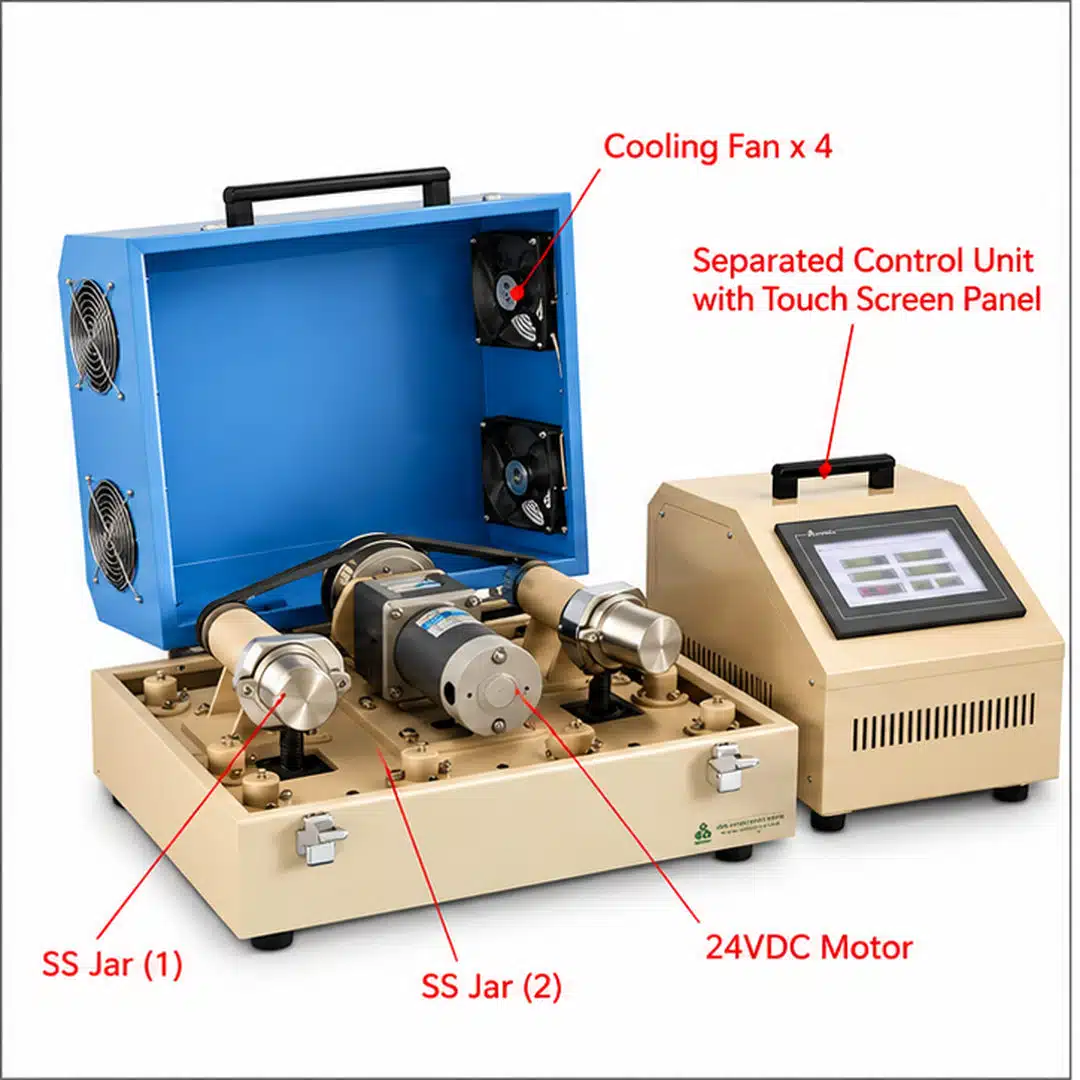
The MSK-SFM-3-II is a programmable dual-jar high-energy ball mill designed for simultaneous grinding, mixing, homogenization, and fine powder preparation of two laboratory samples. Its three-dimensional milling motion combines rotation, vibration, and oscillation to generate high-impact grinding energy, making it suitable for materials research requiring small-volume sample processing and consistent experimental conditions.
The machine features two milling positions and an adjustable operating speed of 300–1000 RPM. The multidirectional milling mechanism promotes repeated collisions between grinding media and sample particles, supporting efficient particle size reduction and uniform mixing. An estimated maximum acceleration of approximately 50G enables high-energy grinding for selected ceramic, metallic, and advanced functional materials.
Powered by a 24V DC motor, the milling unit operates with a separate programmable touchscreen controller. This configuration allows the milling machine to be installed inside a compatible argon-filled glovebox while the controller remains outside the controlled environment. A suitable electrical feedthrough is required for glovebox installation.
The control system supports adjustable speed, milling duration, forward and reverse rotation, and up to three programmable operating segments. These functions allow users to configure repeatable grinding procedures according to different sample materials, milling jars, and experimental requirements.
The referenced equipment package includes four 80 mL grinding jars: two nylon jars with compatible zirconia grinding balls and two stainless steel jars with stainless steel milling media. Two jars can be installed for simultaneous grinding, while the remaining jars provide additional configuration flexibility. The MSK-SFM-3-II is suitable for battery materials, metal oxides, ceramics, powder mixing, and advanced laboratory research.
Key Features
- Dual-Jar Milling System: Two independent milling positions allow simultaneous grinding or mixing of two laboratory samples.
- High-Energy 3D Movement: Combines rotation, vibration, and oscillation for effective fine grinding and powder homogenization.
- Adjustable Milling Speed: Programmable operating speed from 300 to 1000 RPM.
- High-Impact Milling: Estimated acceleration of approximately 50G under specified operating conditions.
- 24V DC Motor: Supports the separate-control design for suitable inert-gas environments.
- Argon Glovebox Compatibility: Designed for operation inside compatible argon-filled gloveboxes using suitable electrical connections.
- Separate Touchscreen Controller: Allows external adjustment of milling parameters without opening the glovebox.
- Three-Stage Programming: Supports configurable speed, milling time, and forward/reverse rotation.
- Four Grinding Jars: The referenced standard package includes two nylon and two stainless steel jars, each with a nominal capacity of 80 mL.
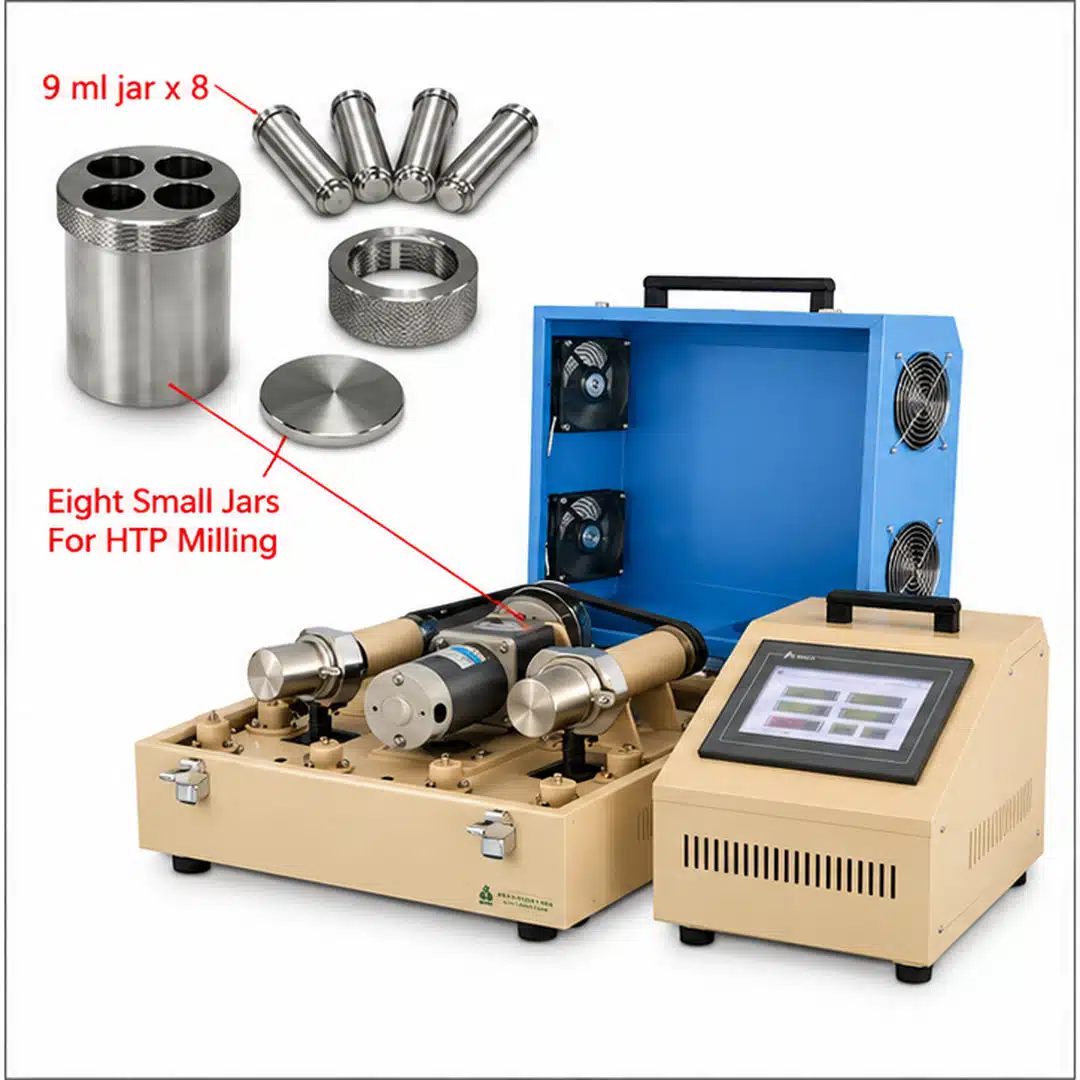
- Optional High-Throughput Processing: Compatible multi-cavity jars may support preparation of up to eight small samples across the two milling positions.
- Flexible Research Applications: Suitable for ceramics, metallic powders, battery materials, metal oxides, and advanced functional materials.
Technical Specifications
| Model | MSK-SFM-3-II |
|---|---|
| Product Type | Programmable Dual-Jar High-Energy 3D Vibratory Ball Mill |
| Milling Motion | Three-dimensional rotation, vibration, and oscillation. |
| Simultaneous Milling Positions | 2 grinding jars can be operated simultaneously. |
| Included Grinding Jars | 4 jars in the referenced configuration: 2 nylon jars and 2 stainless steel jars. |
| Jar Capacity | 80 mL per standard grinding jar. |
| Working Voltage | 110V or 240V AC, single-phase, 50/60 Hz, with appropriate power-supply selection. |
| Power Consumption | 120W. |
| Motor Type | 24V DC motor. |
| Speed Range | 300–1000 RPM, adjustable. |
| Maximum Estimated Acceleration | Approximately 50G under the stated operating conditions. |
| Control System | Separate programmable color touchscreen controller. |
| Programmable Segments | Up to 3 programmed operating segments. |
| Rotation Direction | Programmable forward and reverse rotation. |
| Timer Range | 0–30 minutes. |
| Low-Speed Resonance | Strong resonance may occur below approximately 250 RPM. Normal specified operating range begins at 300 RPM. |
| Glovebox Compatibility | Suitable for compatible argon-filled gloveboxes with an external control arrangement. |
| Electrical Feedthrough | KF40 electrical feedthrough required for glovebox installation; optional accessory. |
| Recommended Feed Particle Size | Less than 1 mm. |
| Particle Size Performance | Median particle size (D50) approaching 0.1 µm has been reported for selected oxide ceramic materials under optimized milling conditions. Actual results are material-dependent. |
| Standard Nylon Jars | 2 × 80 mL nylon milling jars with compatible zirconia grinding media. |
| Standard Stainless Steel Jars | 2 × 80 mL stainless steel milling jars with compatible stainless steel grinding balls. |
| Recommended Jar Loading | Less than one-third of the nominal jar volume. Approximately 15 g of sample is indicated for certain processing conditions. |
| Optional High-Throughput Jar | Four-cavity stainless steel grinding jar; two compatible jars may support up to 8 individual samples per batch. |
| Other Optional Jars | Vacuum-compatible stainless steel, tungsten carbide, alumina, zirconia, and other selected jar configurations. |
| Optional Cooling System | Compatible forced-air cooling equipment may be available for temperature-sensitive materials. |
| Noise Level | Approximately 87 dBA, measured at about 1 ft with the machine lid open and stainless steel grinding balls in the jar. |
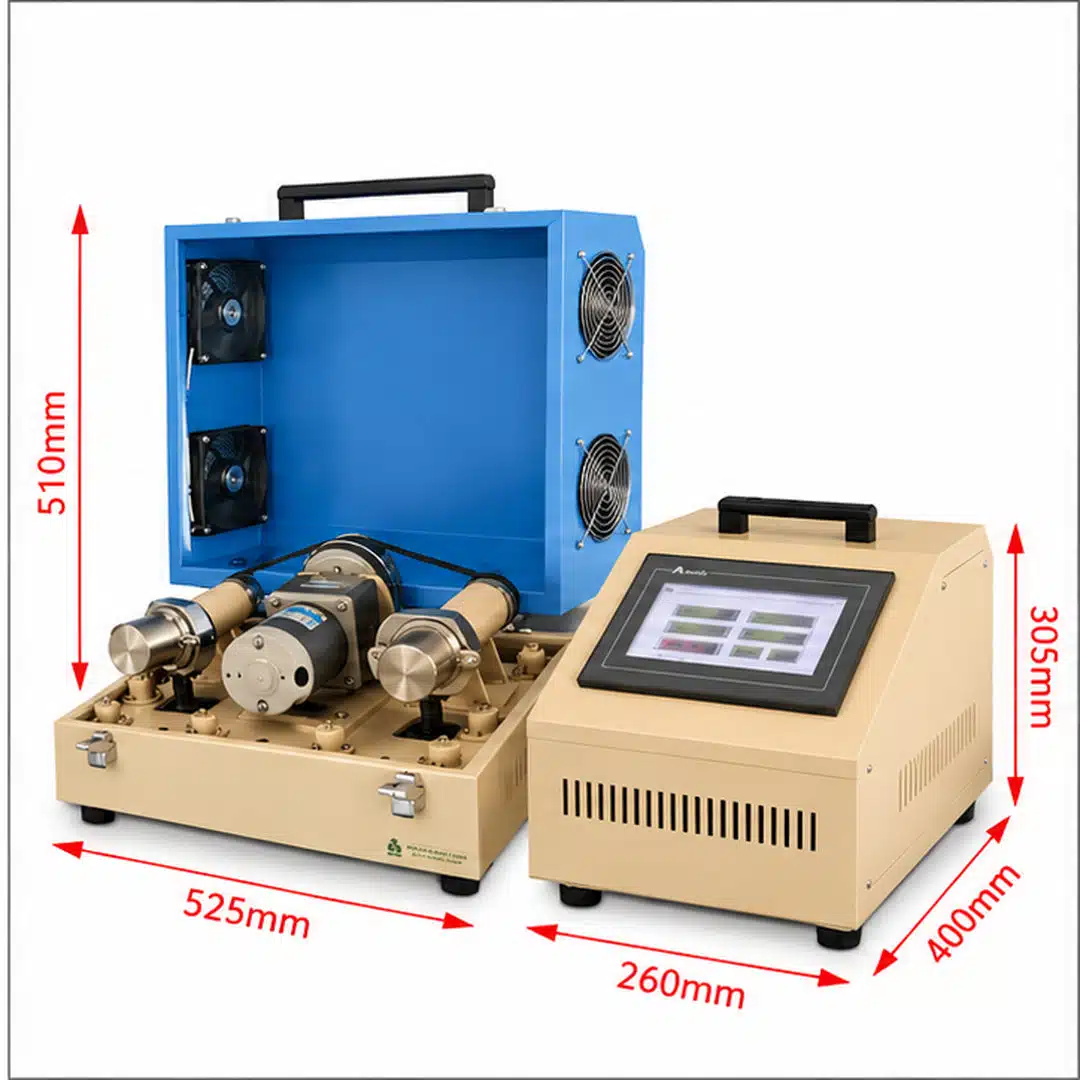
| Dimensions (Lid Open) | 525 × 550 × 510 mm (L × W × H). |
| Dimensions (Lid Closed) | 525 × 380 mm (L × W); closed height requires confirmation. |
| Control Unit Dimensions | 260 × 400 × 305 mm (L × W × H). |
| Net Weight | Approximately 80 kg. |
| Shipping Dimensions | 48″ × 40″ × 36″ (L × W × H). |
| Shipping Weight | 218 lbs. |
| Compliance | CE documentation and optional NRTL certification should be confirmed for the exact supplied configuration. |
| Warranty | A two-year warranty may be offered, subject to the final written sales terms and warranty policy. |
Programmable Control & Glovebox Applications
The MSK-SFM-3-II uses a separate touchscreen control unit for flexible laboratory operation. Users can adjust the milling speed, operating time, and rotation direction while configuring up to three programmable processing segments.
The dual-jar system allows two grinding containers to operate simultaneously, making it suitable for preparing two sample compositions under the same programmed milling conditions. The separate controller also enables remote operation when the milling unit is installed inside a compatible glovebox.
For argon glovebox applications, the machine’s 24V DC motor is located inside the controlled environment, while the control unit remains outside. A suitable KF40 electrical feedthrough is required to connect the two components without compromising the glovebox atmosphere. Installation space, electrical compatibility, and atmosphere requirements should be confirmed before ordering.
Standard Milling Jars & Grinding Media
The referenced standard package includes four grinding jars, allowing researchers to select between stainless steel and nylon grinding containers. Two jars may be installed at one time, while the additional jars provide flexibility for different materials and milling media combinations.
| Jar Configuration | Description |
|---|---|
| 80 mL Nylon Jars | Two nylon milling jars with compatible zirconia grinding media. Suitable for selected nonmetallic powder processing applications. |
| 80 mL Stainless Steel Jars | Two stainless steel milling jars with compatible stainless steel grinding balls. Suitable for general laboratory milling and selected metallic materials. |
| Four-Cavity Stainless Steel Jars | Optional multi-sample milling configuration that may support preparation of up to eight small samples across two milling positions. |
| Vacuum-Compatible Jars | Optional sealed milling jars may be available for selected controlled-atmosphere applications. |
| Tungsten Carbide Jars | Optional wear-resistant grinding containers for compatible hard materials. |
| Alumina or Zirconia Jars | Optional ceramic grinding containers for selected materials research and contamination-control requirements. |
Optional High-Throughput Milling
For laboratories requiring parallel processing of multiple small samples, the MSK-SFM-3-II can be equipped with compatible four-cavity stainless steel milling jars. Using two four-cavity jars in the dual-jar system may allow up to eight individual samples to be processed in a single batch, subject to equipment compatibility and proper loading.
This configuration can support comparative experiments, materials screening, formulation development, and other small-volume laboratory applications where efficient sample preparation is important.
Applications
The MSK-SFM-3-II is designed for high-energy laboratory milling and controlled-atmosphere sample preparation. Its dual-jar configuration and programmable control system make it suitable for different experimental materials and research procedures.
- Lithium-ion battery and solid-state battery materials research
- Air-sensitive and moisture-sensitive powder preparation
- High-energy ceramic and metal oxide grinding
- Metallic powder mixing and material preparation
- Fine particle processing and powder homogenization
- Controlled-atmosphere milling in compatible argon gloveboxes
- Comparative materials research and sample screening
- Small-volume experimental powder preparation
- University, research institute, and industrial R&D applications
Operating Guidelines & Safety Notes
- Balanced Jar Installation: Install compatible jars in both milling positions and maintain properly balanced loading during operation.
- Recommended Sample Loading: Keep the sample volume below one-third of the nominal jar capacity and follow the approved equipment loading limits.
- Feed Particle Size: Reduce sample particles to less than 1 mm where appropriate before milling.
- Grinding Media Selection: Choose milling balls compatible with the grinding jar material and sample. Avoid incompatible media combinations that could cause damage or contamination.
- Glovebox Installation: Confirm argon compatibility, electrical connections, KF40 feedthrough requirements, and available installation space before operation.
- Temperature Management: High-energy milling generates heat. Select suitable operating intervals and optional cooling accessories for temperature-sensitive materials.
- Jar Securing: Ensure both milling jars and all mounting components are correctly installed before starting the machine.
- Noise Exposure: The stated noise measurement is approximately 87 dBA under the specified open-lid test conditions. Appropriate laboratory noise-control measures should be used where necessary.
- Electrical Safety: Confirm the correct power-supply voltage selection before connecting the machine.
- Grinding Performance: Actual particle size depends on sample characteristics, grinding media, milling jar material, operating speed, and milling duration.
Configuration Note: The referenced standard configuration includes four 80 mL grinding jars: two nylon jars and two stainless steel jars. Two jars can operate simultaneously. The KF40 feedthrough, optional high-throughput jars, alternative grinding media, cooling equipment, and additional certification services should be confirmed in the final PENGXIN Machinery quotation. The closed-lid machine height also requires confirmation before publication.


