
Product Overview
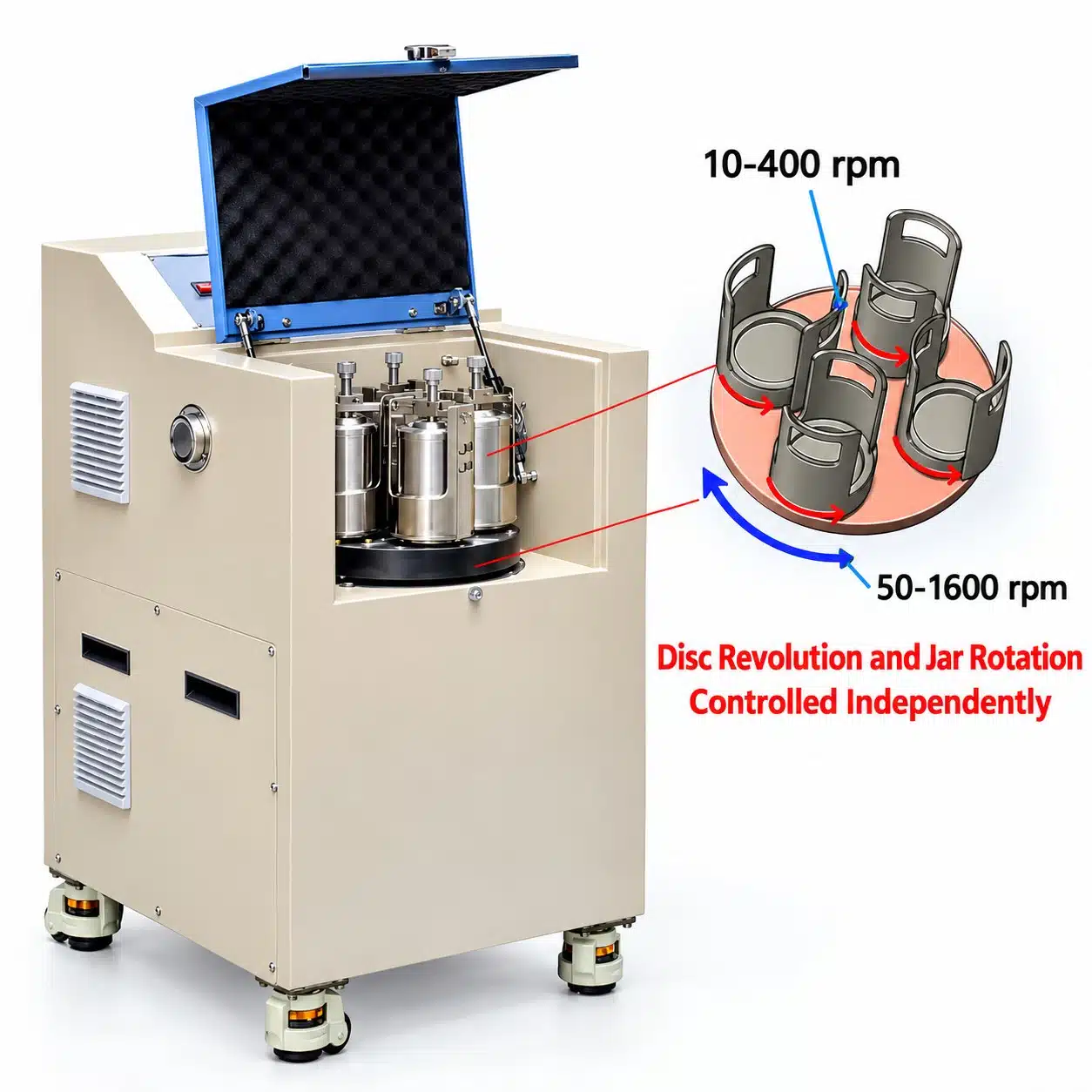
The MSK-SFM-15 is a high-speed laboratory planetary ball mill designed for advanced powder grinding, fine particle preparation, mechanical alloying, and material homogenization. Unlike conventional planetary ball mills with fixed speed ratios, the MSK-SFM-15 features independent speed control of sun-wheel revolution and milling jar self-rotation, allowing researchers to adjust milling conditions according to different materials, particle sizes, and processing requirements.
The sun-wheel revolution speed can be adjusted from 10 to 400 RPM, while the milling jar self-rotation speed ranges from 50 to 1600 RPM. This flexible speed control enables operators to modify the balance between impact and shear forces, making the equipment suitable for a wide range of laboratory applications, from powder mixing and homogenization to high-energy milling and particle size reduction.
Equipped with four planetary milling stations and a programmable touchscreen control system, the MSK-SFM-15 supports precise adjustment of operating speed, milling time, and multi-stage processing sequences. The controller can store up to 10 milling recipes, each containing up to 8 programmable speed segments, helping laboratories perform repeatable experimental procedures.
The referenced standard configuration includes four 500 mL stainless steel grinding jars and matching stainless steel milling balls. Additional milling jar materials, capacities, and specialized high-throughput accessories may be selected according to application requirements. The system is suitable for universities, battery research laboratories, materials science institutes, and industrial R&D facilities.
주요 기능
- Independent Speed Control: Sun-wheel revolution and jar self-rotation speeds can be adjusted separately to achieve different milling conditions.
- High-Speed Planetary Milling: Revolution speed from 10–400 RPM and self-rotation speed from 50–1600 RPM.
- Adjustable Milling Dynamics: Flexible speed ratios allow operators to modify the impact and shear effects applied to different materials.
- Four Milling Stations: Supports simultaneous processing using four compatible grinding jars.
- Programmable Touchscreen: Stores up to 10 milling programs with up to 8 speed-control segments per recipe.
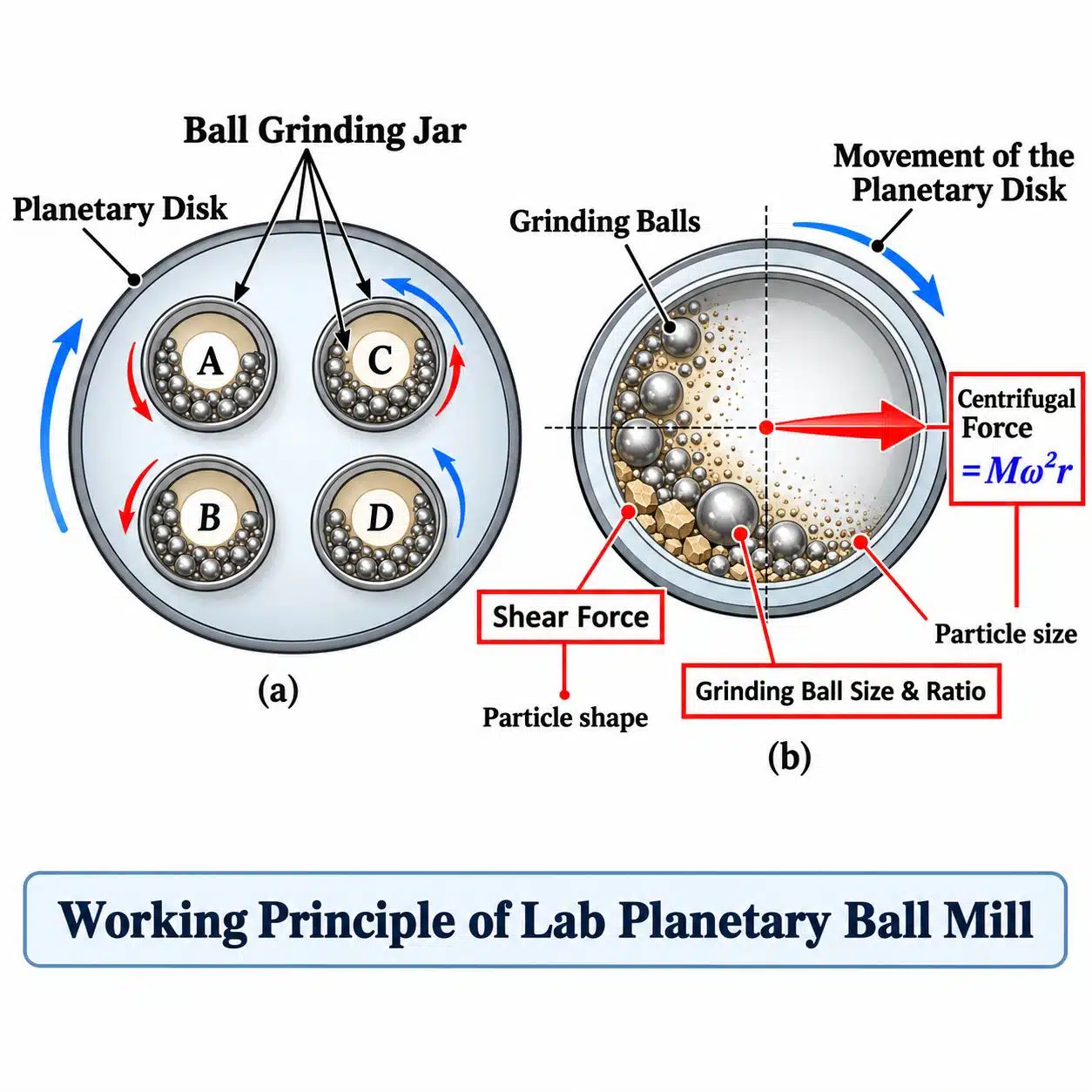
- High-Energy Grinding Capability: Combines planetary revolution and jar rotation to produce strong centrifugal effects for fine particle processing.
- Stainless Steel Grinding Jars: Four 500 mL stainless steel jars with compatible milling balls are listed in the standard equipment configuration.
- Optional Milling Accessories: Alternative jar materials and selected high-throughput milling configurations are available subject to compatibility.
- Versatile Research Applications: Suitable for battery materials, metallic powders, ceramics, metal oxides, minerals, and advanced functional materials.
기술 사양
| 모델 | MSK-SFM-15 |
|---|---|
| Product Type | High-Speed Programmable Planetary Ball Mill with Independent Revolution and Self-Rotation Speed Control |
| Milling Stations | 4 planetary milling positions. |
| Speed Control | Independent adjustment of sun-wheel revolution and milling jar self-rotation speeds. |
| Revolution Speed | 10–400 RPM (sun-wheel revolution). |
| Self-Rotation Speed | 50–1600 RPM (milling jar rotation). |
| Recommended Speed Ratio | Adjustable revolution-to-self-rotation ratio, with a recommended operating ratio range of approximately 1:1 to 1:3, depending on the material and milling conditions. |
| Revolution Centrifugal Acceleration | Less than 16 g under the stated operating conditions. |
| Self-Rotation Centrifugal Acceleration | Less than 120 g under the stated operating conditions. |
| Combined Centrifugal Acceleration | Less than 136 g, based on the stated equipment specifications. |
| Working Voltage | 208–240V AC, single-phase, 50/60 Hz. |
| Rated Power | 3500W. |
| Power Cord | 10 ft power cord without an installed power plug in the referenced configuration. |
| Touchscreen Controller | Programmable touchscreen interface for setting milling speed, operating time, and multi-stage processing sequences. |
| Stored Milling Recipes | Up to 10 programmable milling recipes. |
| Speed Segments | Up to 8 programmable speed-control segments per recipe. |
| Material Feed Size | Less than 3 mm for most materials; less than 10 mm for brittle materials. |
| Wet Milling Output | Average particle size below 1 µm under suitable milling conditions. |
| Dry Milling Output | Particle size below 20 µm under suitable milling conditions. |
| Minimum Achievable Particle Size | Particle sizes as fine as 0.1 µm have been reported for certain materials under optimized conditions. Actual results depend on the material and milling process. |
| Wet Milling Load Limit | Total sample and milling media weight: less than 2000 g at revolution speeds below 350 RPM; less than 1000 g at revolution speeds below 400 RPM. |
| Dry Milling Load Limit | Maximum permitted total load is approximately half the corresponding wet milling limit. |
| Standard Milling Jars | Four 500 mL stainless steel grinding jars in the referenced standard configuration. |
| Standard Grinding Media | Compatible stainless steel milling ball sets included in the referenced configuration. |
| Optional Milling Jars | Alternative materials, vacuum-compatible jars, and selected larger-capacity jars may be available. Compatibility of optional jars up to 2 L must be confirmed for the exact equipment and fixture configuration. |
| High-Throughput Option | Optional high-throughput milling assemblies with eight 25 mL sample containers per station may support processing of up to 32 samples per batch, subject to accessory compatibility. |
| Jar Locking Fixtures | Four sets of mechanical locking fixtures in the referenced configuration. |
| Standard Fixture Jar Height | Up to 80 mm for the referenced locking fixtures; alternative jar sizes require compatibility confirmation. |
| Noise Level | Approximately 55–85 dB, depending on milling conditions. |
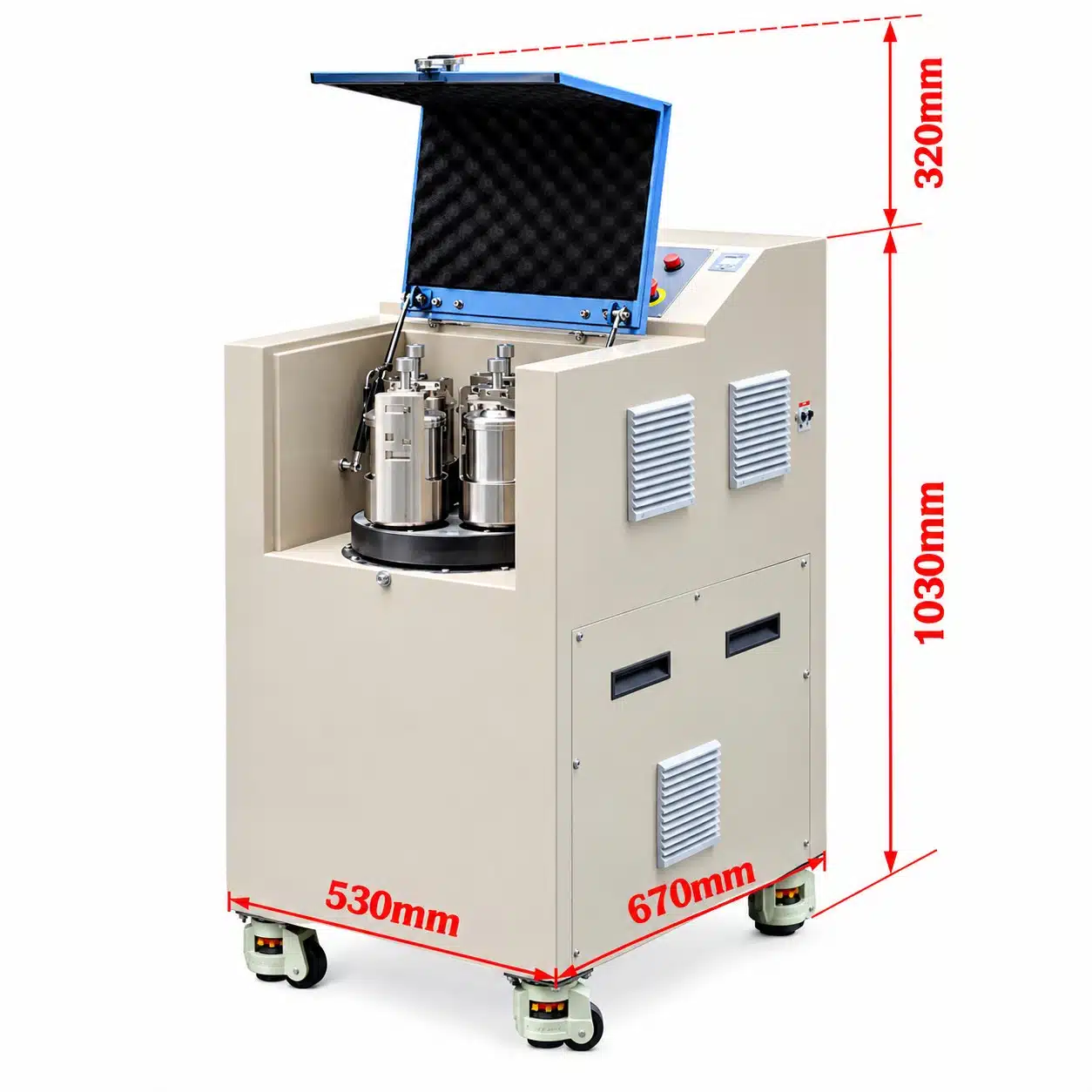
| Dimensions (Cover Closed) | 670 × 530 × 1300 mm (L × W × H). |
| Dimensions (Cover Open) | 670 × 530 × 1620 mm (L × W × H). |
| 순중량 | Approximately 245 kg. |
| Shipping Dimensions | 35″ × 30″ × 55″ (L × W × H). |
| Shipping Weight | 650 lbs. |
| Compliance | CE documentation and optional NRTL certification should be confirmed for the actual supplied machine and destination-market requirements. |
Independent Speed Control & Milling Performance
One of the main advantages of the MSK-SFM-15 is its independent control of revolution and self-rotation speeds. This enables researchers to select different combinations of planetary motion and jar rotation instead of relying on a fixed speed ratio. By adjusting both parameters, operators can modify the mechanical forces applied during milling and optimize processing conditions for specific materials.
Different revolution and rotation settings can influence powder movement, grinding media collisions, impact intensity, and shear action. Lower-energy conditions may be suitable for mixing or homogenization, while higher-energy settings may improve particle size reduction or mechanical alloying efficiency when used within the equipment’s permitted operating limits.
For high-speed milling, it is essential to follow the recommended loading limits. The total mass of samples and milling media must be reduced as operating speed increases. Dry milling also requires lower allowable loading than wet milling. Actual grinding performance depends on the sample properties, milling jar material, grinding ball size, sample-to-media ratio, and processing duration.
Grinding Jars & Accessories
The MSK-SFM-15 accommodates four milling stations and supports different grinding jar configurations to suit laboratory research requirements. The referenced package includes four 500 mL stainless steel jars and compatible stainless steel milling balls. Optional milling containers may be selected according to sample properties, contamination limits, required sample volume, and processing conditions.
- Stainless Steel Milling Jars: Suitable for many general-purpose laboratory grinding and metallic powder processing applications.
- Ceramic and Nonmetallic Jars: Selected alumina, zirconia, nylon, or other compatible materials may be used where metal contamination must be minimized.
- Vacuum-Compatible Milling Jars: Selected sealed or vacuum-compatible configurations may be available for specialized processing requirements.
- High-Throughput Accessories: Specialized multi-sample milling assemblies can improve experimental efficiency for material screening and small-volume sample preparation.
- Optional Larger Jars: Larger-capacity grinding jars, including options up to 2 L where supported, require verification of machine clearance, holding fixtures, permitted load, and operating speed.
Applications
The MSK-SFM-15 is designed for laboratories requiring flexible milling speed control and high-energy powder processing. Its adjustable revolution and self-rotation system makes it suitable for different sample types, research objectives, and experimental milling conditions.
- Lithium-ion battery and advanced energy storage materials research
- Solid-state battery materials and functional powder preparation
- Mechanical alloying and metallic powder processing
- Ceramic materials and metal oxide grinding
- Fine particle preparation and experimental powder processing
- Mineral sample preparation and materials analysis
- Powder mixing, blending, and homogenization
- Advanced functional materials development
- University, research institute, and industrial R&D laboratory applications
Operating Guidelines & Safety Notes
- Balanced Jar Installation: Always install two jars in symmetrical positions with similar total weights or use four evenly balanced jars to maintain stable planetary rotation.
- Single-Sample Operation: When processing one sample, install an appropriately weighted counterbalance jar in the opposite position. Unbalanced loading may cause excessive vibration or mechanical damage.
- Wet Milling Load: Keep the total mass of samples and grinding media below 2000 g when revolution speed is below 350 RPM, and below 1000 g when revolution speed is below 400 RPM, according to the stated equipment limits.
- Dry Milling Load: The allowable total load for dry milling is approximately half of the corresponding wet milling limit.
- Jar and Media Compatibility: Select grinding containers and media according to material hardness, chemical compatibility, and acceptable contamination levels.
- Contamination Control: Where appropriate and safe for the material, conditioning a dedicated jar and grinding media with the same material may help reduce cross-contamination between milling batches.
- Ceramic Milling: For selected ceramic and oxide materials, use compatible nonmetallic jars and grinding media. Do not use stainless steel grinding balls inside alumina jars.
- Secure Jar Fixing: Check the jar locking fixtures and ensure all containers are correctly installed before starting the machine.
- Electrical Requirements: Confirm the supply voltage, current capacity, protective grounding, and suitable plug or hardwired connection before installation.
- Particle Size Results: Final particle size depends on sample characteristics, grinding media, rotational speed, milling duration, and operating conditions.
Configuration Note: Standard milling jars, grinding media, optional accessories, electrical connections, and certification documents should be confirmed in the final PENGXIN Machinery quotation. Larger jar options and high-throughput assemblies require compatibility verification. Technical specifications and achievable grinding results may vary according to the selected equipment configuration and material processing conditions.


