
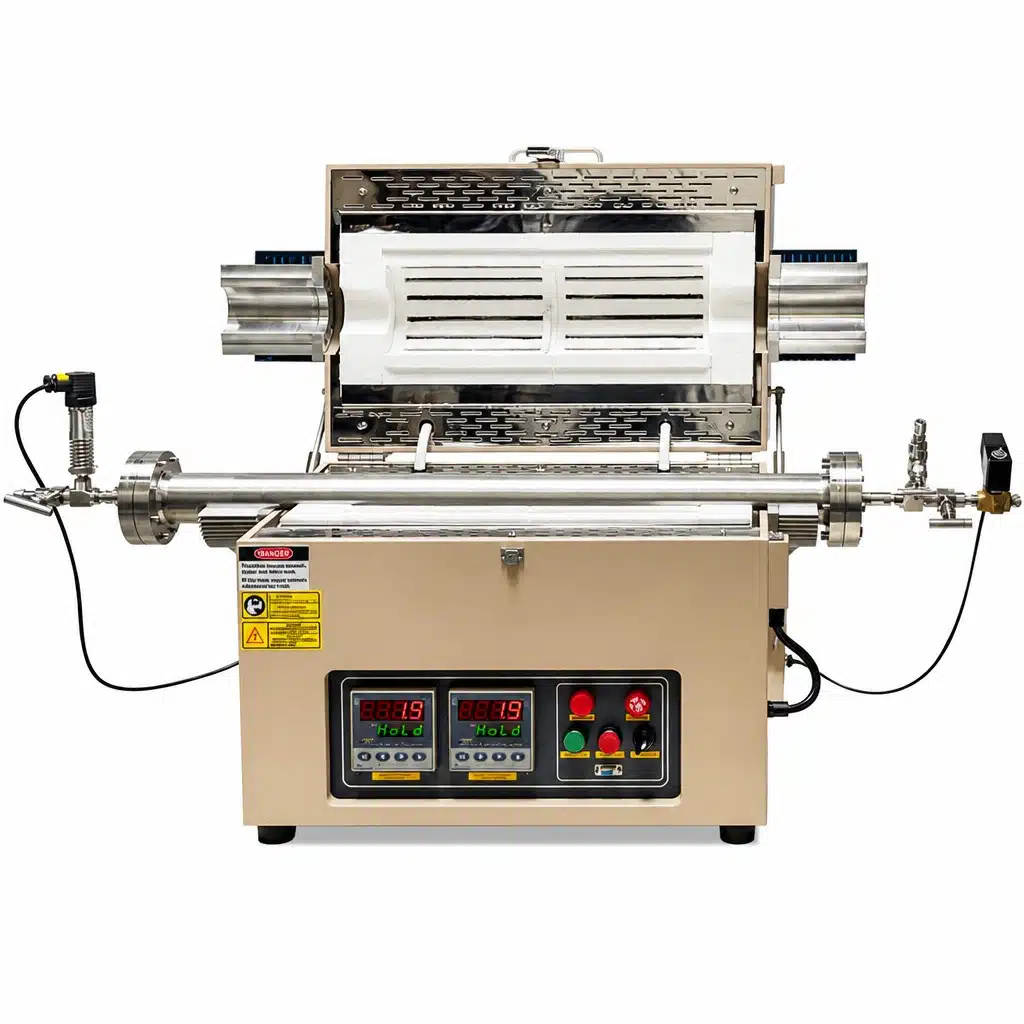
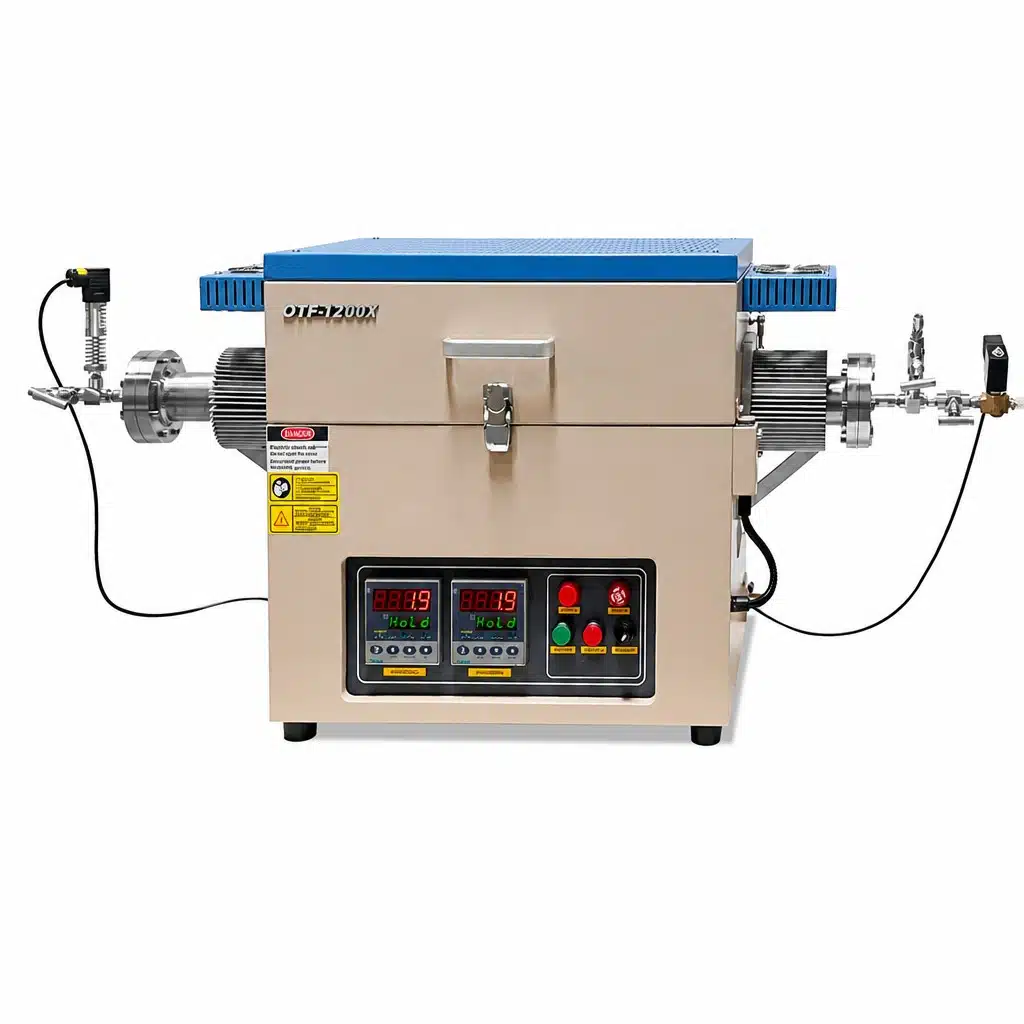
OTF-1200X-HPV High Pressure Tube Furnace with Stainless Steel or Ni-Based Superalloy Tube
The OTF-1200X-HPV is engineered for advanced laboratory applications requiring controlled high-temperature treatment under elevated pressures. It accommodates either a stainless steel 310S refractory alloy tube or a nickel-based superalloy tube, enabling heating processes up to 900°C or 1100°C respectively. This flexibility allows processing of specialized compound materials with or without inert gas atmospheres, supporting research and development in materials science and related fields.
The furnace operates safely at positive pressures ranging from atmospheric pressure up to 800 PSI, depending on the selected tube alloy and temperature. A pressure sensor integrated into the flange continuously monitors internal pressure, displaying real-time values on the front panel controller. An alarm system activates if pressure limits are exceeded, triggering pressure release to ensure operational safety. The unit also supports computer control via included USB cable and software, facilitating precise temperature and pressure management.
Wichtigste Merkmale
- Choice of processing tubes: Stainless Steel 310S (60 or 80 mm diameter) or Ni-based superalloy (60 mm diameter) for high temperature and pressure resistance.
- Maximum heating temperatures: 900°C for stainless steel tube, 1100°C for Ni-based superalloy tube with specified time limits.
- Operating pressure range from atmospheric to 800 PSI, varying with temperature and tube material.
- Integrated pressure sensor and alarm system with upper and lower limit controls for safe operation.
- PID temperature control with ±1°C stability and over-temperature protection.
- Single heating zone with 440 mm total length and 150 mm constant temperature zone.
- Computer interface included for remote monitoring and control via USB and dedicated software.
Technische Daten
| Parameter | Spezifikation |
|---|---|
| Tube Alloy Options | Stainless Steel 310S (80 mm O.D. x 70 mm I.D. or 60 mm O.D. x 50 mm I.D.) or Ni-based superalloy (60 mm O.D. x 52 mm I.D.) |
| Maximum Heating Temperature | 900°C max (Stainless Steel), 1100°C max (Ni-based superalloy) |
| Operating Pressure Range | 0 to 15 MPa (up to 800 PSI), pressure limits vary with temperature and tube material |
| Heating Element | Fe-Cr-Al alloy doped with Mo |
| Heating Zone Length | 440 mm total, 150 mm ±1°C constant temperature zone |
| Temperaturregelung | PID control with over-temperature protection, stability ±1°C |
| Thermoelement | Omega 3 mm OD K Type with high-temperature tolerant connector (220°C) |
| Pressure Sensor | Installed in high-pressure flange, displays real-time pressure |
| Stromversorgung | AC 220V, 50/60 Hz, 2.5 kW (requires 20A breaker) |
| Erwärmungsgeschwindigkeit | Up to 30°C/min (Stainless Steel tube), up to 20°C/min (Ni-based superalloy tube) |
| Working Gases | Inert gases, hydrogen; oxygen allowed with Ni-based superalloy tube |
Typische Anwendungsbereiche
Ideal for high-pressure thermal treatments in materials research, including sintering, annealing, and chemical vapor deposition under controlled atmospheres. Suitable for processing thermoelectric ceramics, advanced alloys, and other compounds requiring precise temperature and pressure conditions.
Hinweise zur Konfiguration und zum Betrieb
- Choose tube alloy and size according to maximum temperature and pressure requirements.
- Use small quartz or alumina boats to hold samples inside the tube; avoid direct contact with the vessel to preserve tube life.
- Gold or nickel foil wrapping of crucibles is recommended to minimize contamination.
- Optional torque wrench available to ensure proper flange bolt tightening without damage.
- For electrical property measurements under high pressure and temperature, order alumina testing fixtures and high-pressure electrical feedthroughs separately.
- Safety precautions must be observed when using flammable, toxic, or corrosive gases; consult engineering support for proper setup.
- Install a two-stage pressure regulator on gas cylinders to limit input pressure below 3 PSI for safe operation.


