
VBF-1100X-RTP-ASD Fully Automatic Bottom-Loading Rapid Thermal Processing Furnace with 1100°C Max, 50°C/s Heating Rate, and Atmosphere Control
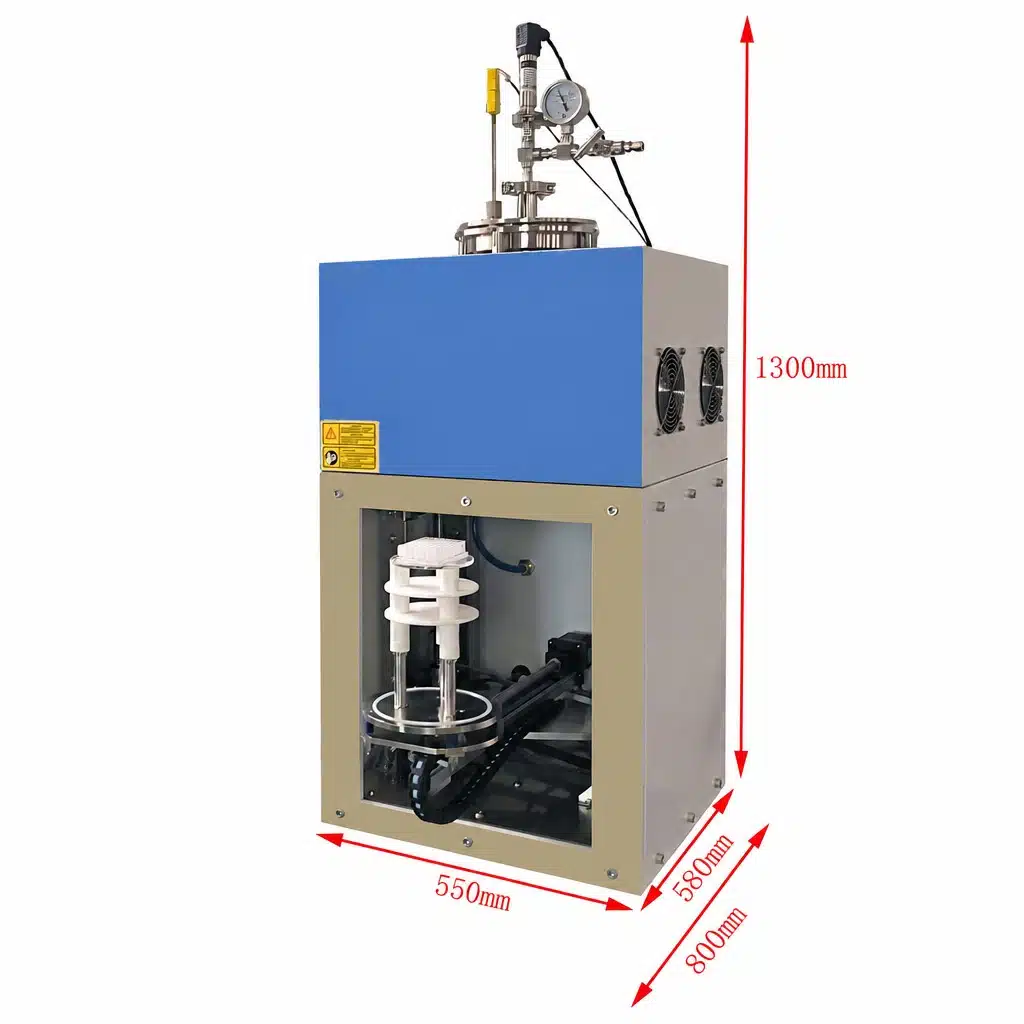
The VBF-1100X-RTP-ASD is engineered for rapid thermal processing tasks requiring precise atmosphere control and high throughput, such as single-atom catalyst synthesis and wafer annealing up to 6 inches. Its bottom-loading design facilitates automated sample exchange within a sealed quartz chamber, ensuring controlled processing environments.
This furnace employs 12 shortwave infrared lamps arranged to provide a uniform heating zone of 210 mm diameter by 100 mm height, capable of heating rates up to 50°C per second from room temperature to 900°C. Continuous operation is supported up to 1000°C, with short-duration exposure to 1100°C for up to 30 minutes, suitable for advanced thermal treatments.
Wichtigste Merkmale
- Bottom-loading airtight quartz chamber (Ø200 × H100 mm) with water-cooled stainless steel flange sealing for atmosphere control.
- 12 infrared lamps delivering a total of 18 kW power, enabling rapid heating rates up to 50°C/s.
- Programmable PID temperature control with touchscreen interface and up to 50 temperature segments.
- Integrated vacuum and pressure monitoring with mass flow controllers for gas purging and protective atmospheres.
- Automated sample loading/unloading sequences and multi-unit PC control for high-throughput workflows.
- Optional robotic arm integration for autonomous sample handling and process coordination.
- Includes a KJ5300 water chiller for flange cooling to maintain system integrity during operation.
Technische Daten
| Parameter | Spezifikation |
|---|---|
| Modell | VBF-1100X-RTP-ASD |
| Stromversorgung | 208 VAC, three-phase, 50/60 Hz |
| Maximale Leistung | 18 kW |
| Quartz Chamber Dimensions | Ø200 × H100 mm |
| Heating Zone Dimensions | Ø210 × H100 mm |
| Heizelemente | 12 shortwave infrared lamps, 1.5 kW each |
| Continuous Operating Temperature | 1000°C |
| Maximum Operating Temperature | 1100°C (up to 30 minutes) |
| Erwärmungsgeschwindigkeit | Up to 50°C/s (recommended 10°C/s from room temperature to 900°C) |
| Cooling Rate (Sealed Chamber) | 55°C/min (800°C to 350°C), 5°C/min (350°C to 200°C) |
| Cooling Rate (Open Chamber) | 200°C/min (800°C to 350°C), 35°C/min (350°C to 50°C) |
| Thermoelement | Typ K |
| Temperaturregelung | PID control, touchscreen interface, ±1°C accuracy standard, optional ±0.1°C Eurotherm upgrade |
| Pressure Control | Vacuum and micro-positive pressure monitoring (103,000–120,000 Pa) |
| Gas Flow Control | Mass flow controller, 0–5000 sccm, programmable gas purging and protective gas introduction |
| Sample Stage | Standard diameter 105 mm, rectangular recess 76 × 58 mm; custom stages available for 6″ wafers |
| Automation | PC software for multi-unit control, programmable sequences, data logging, optional robotic arm integration |
| Included Cooling | KJ5300 water chiller for flange cooling |
Typische Anwendungsbereiche
This furnace is ideal for rapid thermal processing in materials research, including single-atom catalyst preparation, wafer annealing, and thermal treatment of semiconductor materials. Its atmosphere control and programmable sequences support vacuum, protective gas, and air sintering processes.
Hinweise zur Konfiguration und zum Betrieb
The system includes a water-cooled stainless steel flange sealing assembly and an airtight quartz chamber. The bottom-loading mechanism enables automated sample exchange controlled by integrated software. The included KJ5300 water chiller must be connected during operation to maintain flange cooling.
Optional vacuum pumps and robotic arms are available separately to extend functionality for reduced-pressure processing and automated sample handling. Users should verify facility power compatibility (208 VAC, three-phase) and confirm sample stage configurations for full 6″ wafer processing.
Automated process workflows include programmable temperature profiles, gas flow control, vacuum evacuation, and sample exchange at controlled temperatures. Safety precautions should be observed when opening the chamber at elevated temperatures and when handling gases.


